Vanilla Minecraft automation has its limits. AFK farms and auto-smelters work well enough, but players who want true factory-scale automation will eventually hit a wall. The Create mod tears that wall down entirely, adding hundreds of blocks and mechanics that let you build automated contraptions of any size. Conveyor belts, mechanical drills, crop harvesters, hidden moving bases, and much more all become possible. This guide covers how to download, install, and start using Create on both your server and client.

What Is the Create Mod?
Create is a large-scale automation mod for Minecraft, available for Forge, NeoForge, and Fabric. It is owned by simibubi (Forge/NeoForge edition) and maintained separately for Fabric by tropheusj, Pepper_Bell, and thatguynamedalpha. The mod supports Minecraft 1.20.1 and 1.21.1, with the current release being Create 6.0.x. It adds hundreds of new blocks that generate and transmit rotational force to power automated contraptions, from simple bulk smelters to complex multi-stage production lines. Setting up a modded Minecraft server is the best way to share all of it with friends.
Create Mod Download
- Visit the Create Mod page on CurseForge or Modrinth for either Forge/NeoForge or Fabric.
- Press Files near the top to view all available versions.
- Scroll down and locate the version matching your Minecraft installation (1.20.1 or 1.21.1).
- Click the Download button on the right-hand side.
- Save the file to a safe location, as it will be needed shortly.
Dependencies
Forge / NeoForge Version:
Create 6.0 bundles Flywheel internally — no separate Flywheel download is needed for current versions. If you are running an older Create version on Forge 1.18.2 or lower, download the matching version of Flywheel separately.
Fabric Version:
To run Fabric mods, download the matching version of Fabric API and install it alongside Create.
Server Installation
For a full walkthrough of adding mods to your Minecraft server, see the dedicated guide. The steps for Create are:
- Navigate to your Apex server panel, then stop the server.
- Scroll down to the Game File section, then open the dropdown menu.
- Ensure you are running the matching version of Forge, NeoForge, or Fabric.
- Afterwards, enter the FTP File Access in the left-hand menu, then log in.
- Locate or create the mods folder, then enter it.
- Press Upload in the top-left, then drag + drop mod files into the right side.
- Once at 100% uploaded, return to the main panel page.
- Restart the server to load Create mod for use.
If you prefer Fabric, see the guide on setting up a Fabric server before proceeding with the steps above.
Modbox Installation
As an alternative to the manual installation, you can install Create on your server using Modbox, our built-in mod browser with direct CurseForge integration.
- Log in to your Apex Hosting account and open your Minecraft server panel.
- On the left side, select
Server Configuration > Modbox.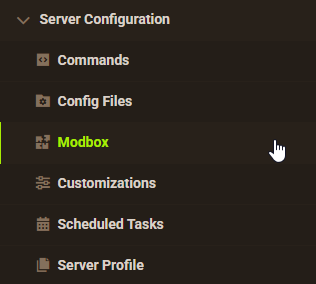
- Search for the mod you want and open its mod page.
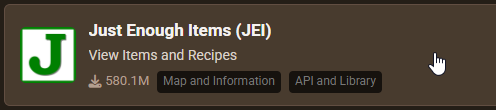
- Select the recommended version for your server, then click
Install.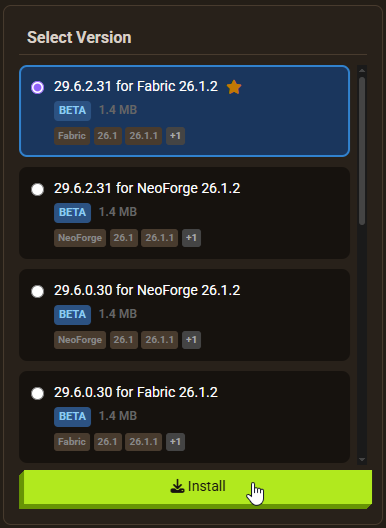
Note: Modbox automatically matches mods to your server's installed version, but does not install dependencies automatically. For more details on using Modbox, check out our full Modbox guide.
Create 6.0 has no required dependencies on Forge or NeoForge, as Flywheel is bundled in. If you’re running an older Create version on Forge 1.18.2 or lower, Flywheel is required separately. Fabric users need Fabric API installed. Search for and install any required dependency individually through Modbox using the steps above, before installing Create itself.
Client Installation
For a complete breakdown of installing Minecraft mods on the client, see the dedicated guide. For Create specifically:
- Before proceeding, ensure you have installed Forge, NeoForge, or Fabric client-side.
- Open your Minecraft launcher, then proceed to Installations at the top.
- Hover over your modded profile, then press the Open Folder icon.
- In the new window, locate or create the mods folder, then enter it.
- Here, paste your Create .jar with its required dependency.
- Afterwards, return to the MC launcher and press Play on your mod profile.
How to Get Started
Once you join the game, the mod is ready to explore. Each block and part has its own function, and Create provides several built-in ways to learn what everything does.
Learning the Controls
Pondering is the primary way to understand any item. Open your inventory, hover over an item, and hold W to ponder it. A screen appears showing animations, descriptions, and use cases for that specific block. Controls at the bottom let you identify objects, change scenes, replay, and adjust text speed.
For items like the Linked Controller, hold Shift instead to view a summary, including a brief description and key information. For control-heavy items, holding Ctrl displays the available input options, such as right-click functions, sneak-clicking, and more. Many items have multiple uses depending on how you interact with them.
Notable Blocks
Create organises its gameplay around rotational force — nearly every machine requires it. Here are the key blocks to understand first.
Shafts and Cogwheels

Shafts carry rotational force from one point to another, forming the backbone of most contraptions. Cogwheels combine with shafts to transfer that force to machines, change rotation speed, and connect components at different angles. Both small and large cogwheels are available.
Belts, Chutes, and Fans

Belts attach to shafts and transport items and mobs in any direction, including elevated angles. Chutes route items downward, often into chests or onto belts. The smart chute variant filters which items pass through. Fans blow or pull items and mobs based on their rotational input — the faster the rotation, the stronger the airflow.
Pulley, Bearings, and Chassis

The pulley moves attached blocks up and down, making it ideal for elevators. Combine it with the Super Glue item to move entire assembled structures. Bearings spin the structure placed above them when given rotational force. Chassis blocks extend that capability, letting you attach additional blocks to form custom shapes. Pair chassis with bearings to create spinning machines like rotating drills or crop harvesters.
Drill and Saw

The drill automatically breaks any block directly in front of it. Attach it to a moving contraption to build an automatic miner that deposits collected blocks into an attached chest. The saw processes wood automatically: a log becomes stripped, then yields 6 planks. Attached to a moving contraption, the saw can fell an entire tree by cutting the lowest block.
Example Builds

These examples show what the blocks above can accomplish together. They are starting points — the actual depth of Create comes from combining mechanics in your own ways. You can also explore Create-based modpacks for pre-built experiences that expand the mod further.
Automatic Bulk Smelter
Combine a fan with a source of lava and you get a bulk smelting setup that processes large quantities of items without individual furnaces or fuel. The fan provides airflow, the lava provides heat. Add a chute above the fan intake for stacks of 16 items per drop, and attach a conveyor belt to the output to move finished ingots into storage automatically.
Spinning Crop Harvester
A mechanical bearing, a set of harvesters, and a few chassis blocks combine into a rotating arm that sweeps across a crop field. The crops drop to the ground or into an attached chest for later collection or further automation.
Hidden Underground Base
A gantry shaft, gantry carriage, and Super Glue let you move entire structures up and down. This makes fully retractable buildings possible — raise the base out of the ground when needed, lower it back underground when not in use. The same mechanics work for extending bridges or opening large doors. Moving large structures puts load on the game, so test scale carefully before committing to a large build.
Clock Tower
A clockwork bearing, linear chassis, and secondary chassis work together to track in-game time. The two chassis types form the minute hand and hour hand respectively. Power the bearing and the hands begin moving. The tower exterior is yours to design.
Common Issues
The mod crashes during startup:
This usually means an incorrect version or a missing dependency. Verify that your Fabric API (if on Fabric) is installed and matches your Minecraft version. Confirm that your mod loader, Create jar, and any dependencies all target the same Minecraft version. After fixing any mismatch, restart both the game and the server.
I cannot join the server:
This error typically means Create is installed on the server but not on your client, or vice versa. Both sides must have the same version of the mod installed directly in the mods folder. Also confirm you are launching the correct Forge, NeoForge, or Fabric profile rather than the vanilla launcher. Relaunch and reconnect after making any changes.